Another Species of Imagination: Cristina Schek’s ‘Kindred Spirits’ at Digitalism, British Art Fair, Saatchi Gallery
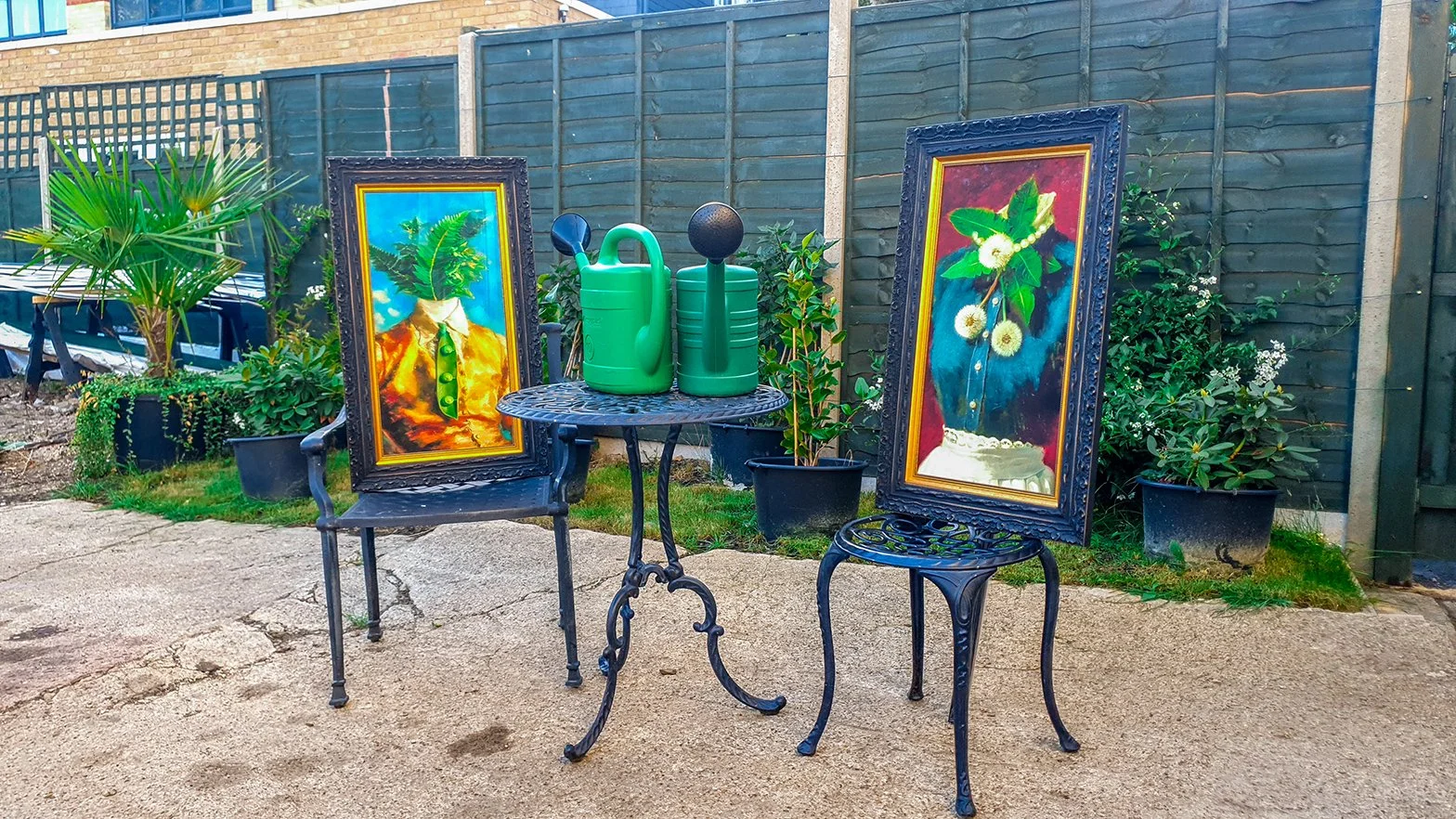
For British Art Fair 2026, Cristina Schek returns to DIGITALISM at D11, top floor, Saatchi Gallery, with Kindred Spirits, a presentation exploring companionship, instinct and our increasingly complicated relationship with the natural world. The artist is also exhibiting with Cynthia Corbett Gallery at Stand 18, who champion her work and support its development across exhibitions, art fairs and international presentations.
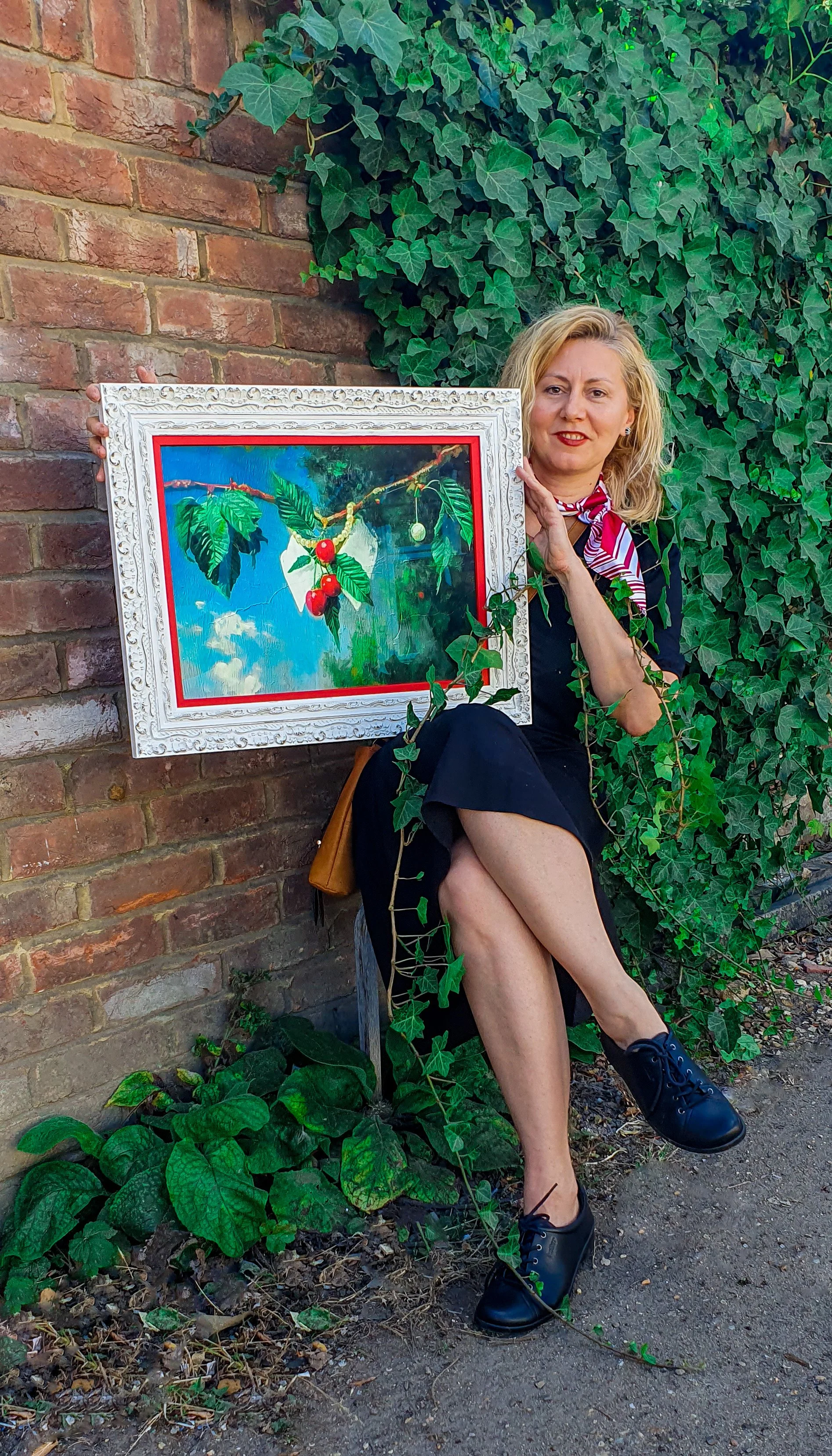
With Kindred Spirits, we enter a world where animals, plants and human rituals begin to exchange roles. Cats become lunar presences, dogs carry something solar and devoted, while in her new The Botanical Gentry works, vegetation steps directly into the human figure. A pea pod borrows a gentleman’s tie, dandelions wear pearls and a cherry branch dresses for the occasion.
Playful and strange, these works ask a larger question: in an increasingly digital world, what might animals and plants remind us about being human? In this interview, the artist discusses kinship, inheritance, instinct, imagination and the natural world, and why these questions have become increasingly central to her practice.
1. What does Kindred Spirits mean to you, and where did this body of work begin?
Cristina Schek:
Kindred Spirits grew out of a question about kinship: what happens when the boundaries between human, animal and plant life become less reliable? I had already been working with transformation in Fern Boy and Fern Girl, where it is never entirely clear whether the human is becoming vegetation or the vegetation has discovered a human form. I realised I was more interested in not knowing exactly what was becoming what.
The question then expanded. Plants began borrowing our clothes and jewellery. Cats and dogs linger in windows and on sofas, poised at the edge of the domestic world before slipping into something more astral, where even aliens may find them. Pearls moved from human portraiture to botanical portraiture, from animals to frames. The human figure gradually dissapeared, but traces of humanity remained everywhere: tenderness, vanity, companionship, ritual, attachment, grief, humour.
There are no humans in these pictures. What remains are their clothes, pearls, curtains, sofas, shoes, portrait poses and habits of display, inherited by other inhabitants. Nature has learned our dress code. Animals have inherited our furniture. Something in the sky is taking an unhealthy interest in everybody. Maybe this is what I mean by kindred spirits: not beings who are identical to us, but creatures in whom we recognise something of ourselves without requiring them to become human.
2. The Botanical Gentry continues the strange family begun with Fern Boy and Fern Girl. What drew you further into this botanical lineage?
Cristina Schek:
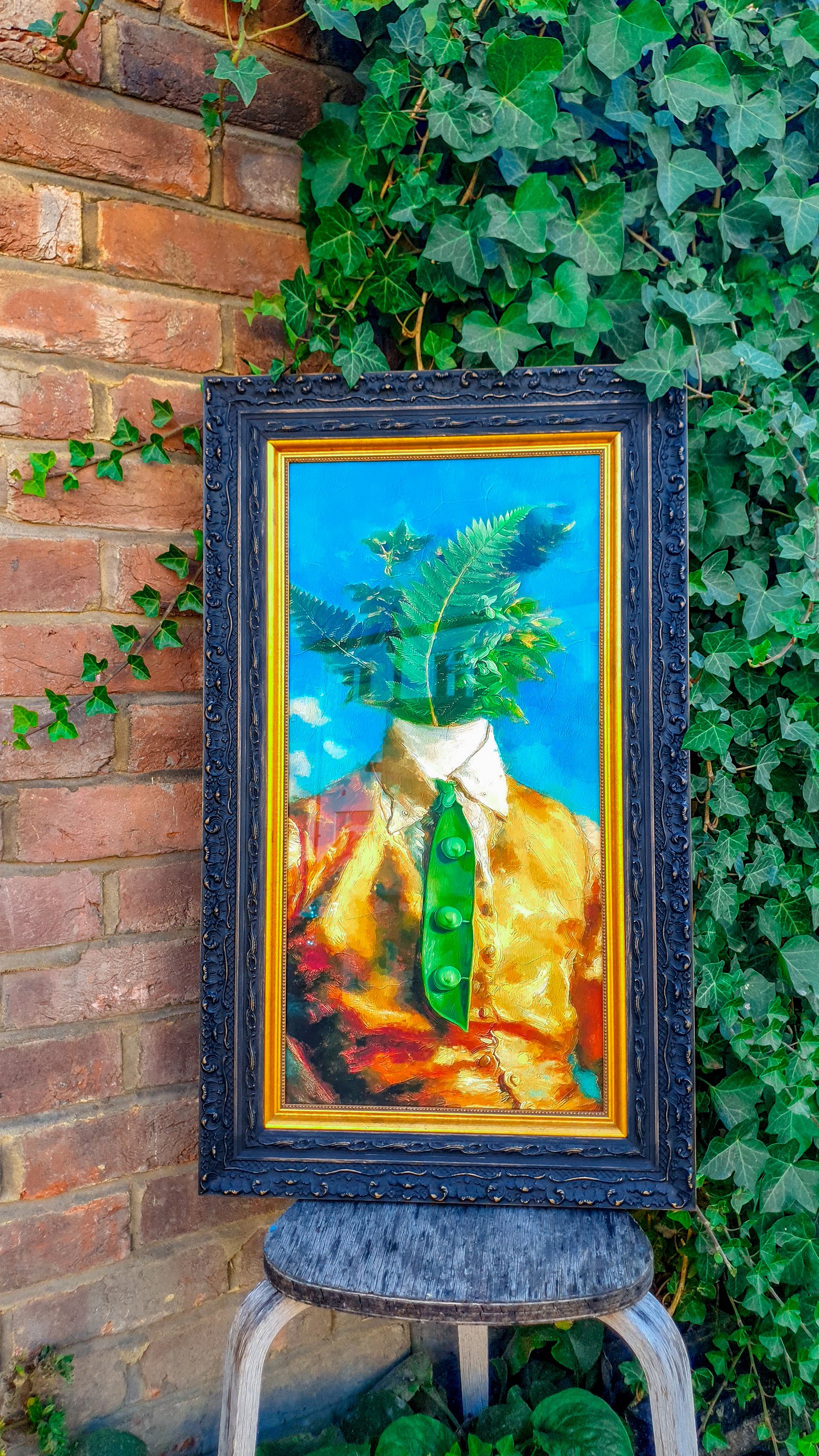
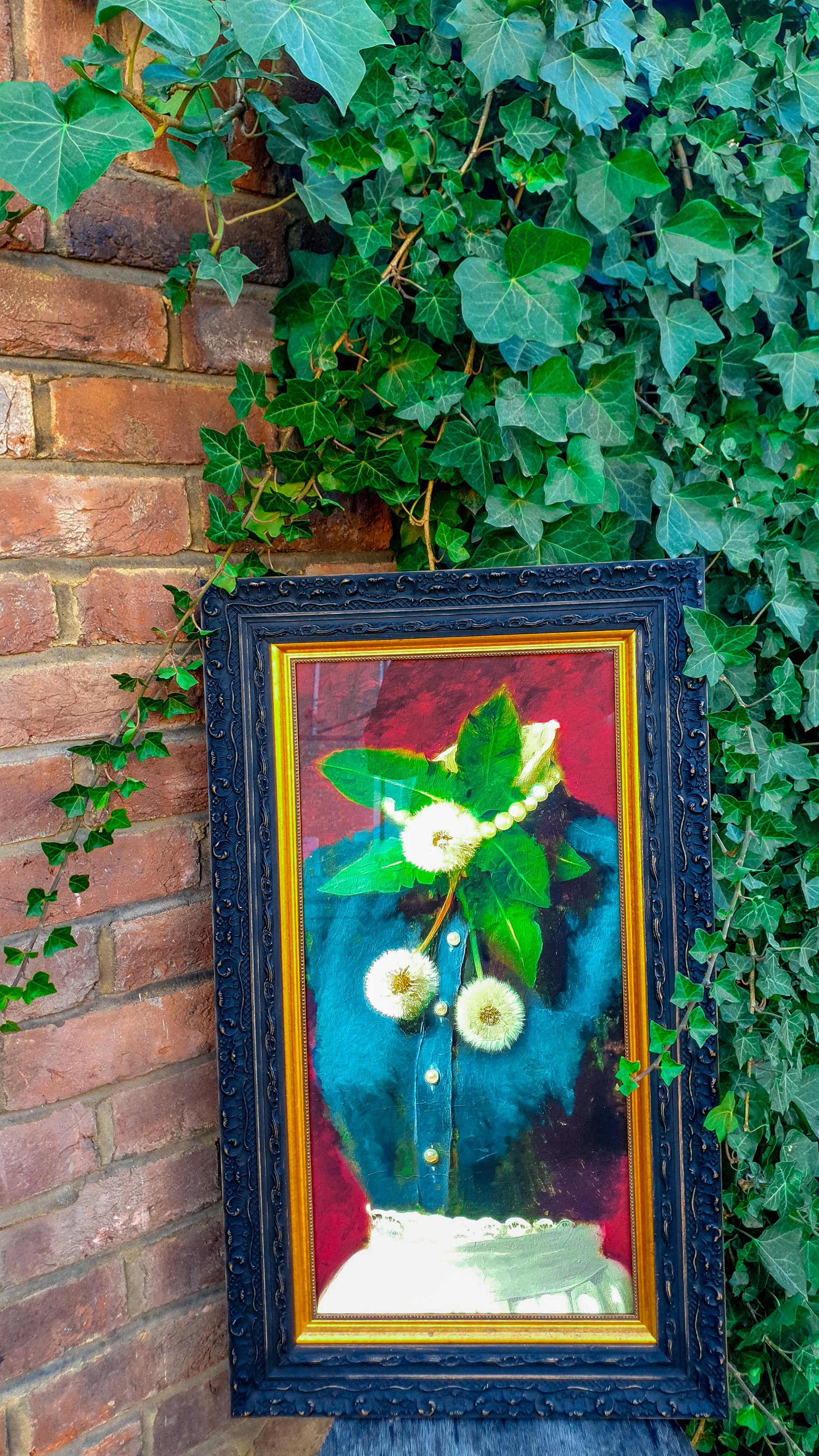
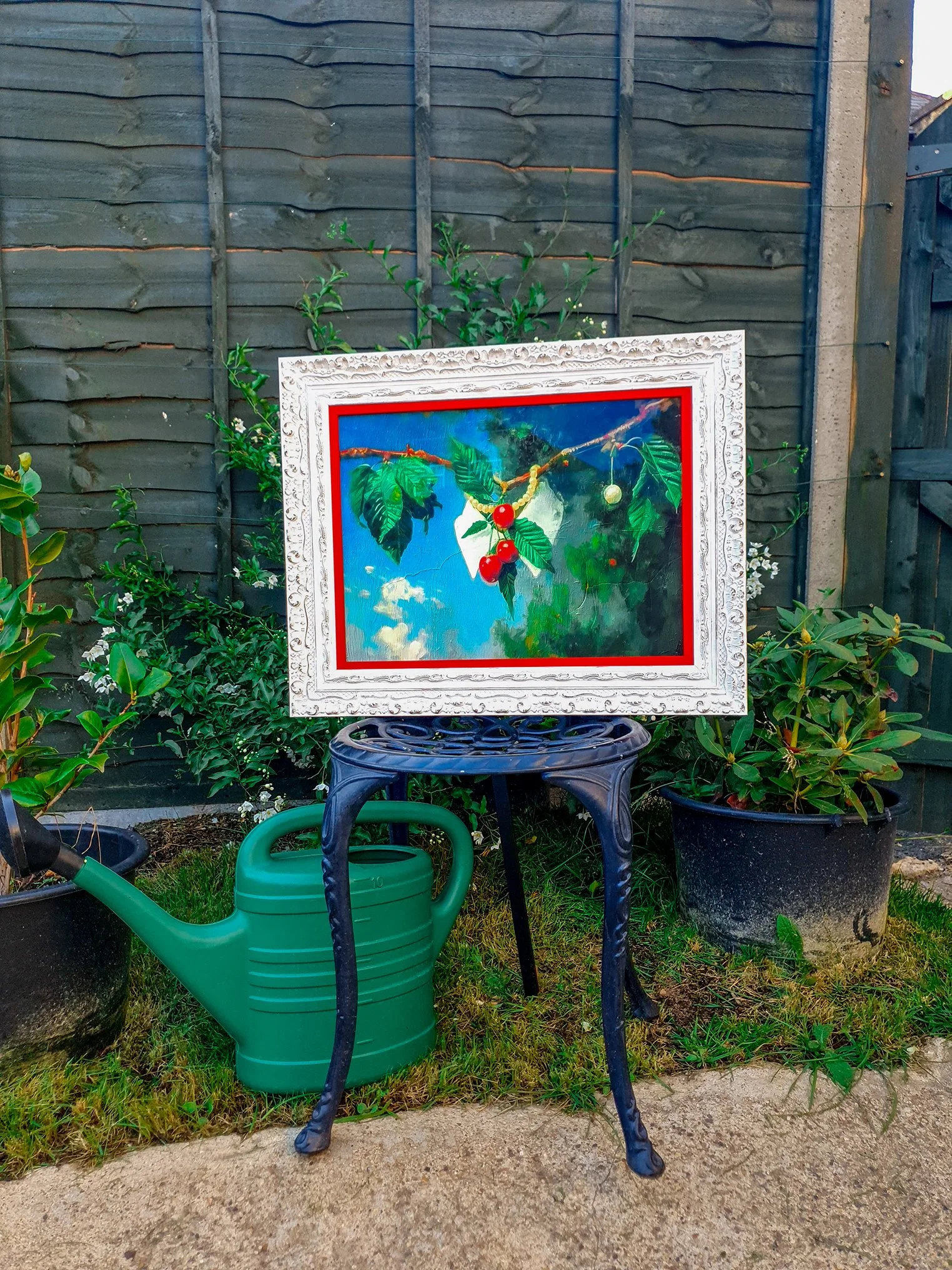
The Botanical Gentry continues that family quite literally. In these new works, plants borrow our clothes, our jewellery and even our manners, inhabiting the space where the human figure ought to be. A pea pod becomes a gentleman’s tie, dandelions wear pearls and a cherry branch dresses for the occasion. At first glance there is something playful and faintly aristocratic about them, but beneath that is a deeper question about inheritance and our relationship with the natural world.
That becomes particularly explicit in Lord Fern Mendelpea. Gregor Mendel grew a great many pea plants and noticed that certain features travelled from parent plants to their offspring. His experiments eventually became foundational to our understanding of inheritance. So the pea-pod tie is not simply an eccentric fashion choice. It is a clue. Mendel leads us to peas, peas to inheritance, inheritance to genes and DNA. Meanwhile, the fern where his face ought to be places him firmly within the same strange botanical family as Fern Boy and Fern Girl.
Human clothes remain, but nature has taken over the portrait. There is something I love about this reversal. We spend so much time imagining ourselves as separate from the natural world, yet our bodies carry ancient instructions inherited through life itself. In an increasingly digital world, these figures seem determined to remind us that beneath all the screens, systems and clever machinery, we remain creatures of inheritance, instinct, appetite and the living world.
3. Pearls appear throughout Kindred Spirits. Why have they become so important?
Cristina Schek:
There is something peculiar about pearls. Human beings have spent centuries wearing them as evidence of beauty, status, femininity, ceremony and, occasionally, having a grandmother with excellent jewellery. But a pearl is not really ours. It is made inside another living creature. We find it, remove it from its original circumstances, thread it onto a necklace and become rather grand about the whole arrangement.
I started thinking about this while making the botanical portraits. Cherries became breasts, leaves became faces, dandelions began to resemble elderly relations and pearls appeared around botanical necks. At first I thought I was dressing nature as a human being. Then I noticed something interesting: I was using nature to dress nature as us. Suddenly, it was no longer clear what was becoming what.
Had the human become plant, or had the plant learned to become human?
The pearls kept crossing boundaries, too. They moved from human portraiture to botanical portraiture, from plants to animals and eventually out of the pictures altogether. Some appear physically on the frames themselves. At some point, the distinction between the imaginary world and the object containing it became unreliable. I’ve always loved unreliable narrators in literature and this is the visual equivalent: an unreliable image, where the frame itself is part of the fiction.
I really like that the pearl belongs to several worlds at once. It belongs to humans through adornment, to another species through its origin, to the botanical figures as borrowed jewellery and to the moon through its old association with lunar light. A tiny pearl containing multitudes.
4. Cats belong to the moon and dogs to the sun in your works. Where did that distinction come from?
Cristina Schek:
Cats definitely belong to the moon. Nocturnal, changeable, watchful, private. They disappear and return according to rules nobody can explain to us. The moon itself behaves similarly: present, absent, full, diminished, never actually gone. A cat beneath a crescent moon doesn’t really need explaining. It just is.
Dogs belong to the sun. Warmth, loyalty, outwardness, physical presence, enthusiasm. Dogs run towards things. They occupy the world bodily. Even the dog sitting formally on the red sofa has a solar quality: I am here. This is my sofa. What are we doing today?
My whole theory is not scientifically proven, of course, but neither is much of what humans have believed about cats, dogs, the moon or the gods.
Human beings have an extraordinary relationship with cats and dogs. We voluntarily invite another species into our homes, give them names, explain our problems to them, allow them onto furniture despite previous declarations to the contrary, photograph them constantly, mourn them, sleep beside them, buy them absurdly expensive food and occasionally organise an entire day around whether somebody has been walked. We call this ownership, although the evidence is inconclusive.
Somewhere during all this, these animals become repositories for profoundly human things: companionship, devotion, loneliness, jealousy, grief, comfort and the ancient domestic question of who exactly owns the sofa. And yet I don’t want the animals in these pictures to become little humans in fur coats. They have a world of their own. Kindred spirits, perhaps, but not identical ones. Another species of imagination.
5. Why present a body of work so concerned with nature, animals and the living world within DIGITALISM?
Cristina Schek:
This strange coexistence is exactly what interests me. I’m using digital processes to make work about animals, plants, inheritance, instinct and our relationship with the living world. The digital medium is not the opposite of nature. It is simply another way of thinking, constructing and imagining. What interests me more is the idea that technology somehow removes us from nature, as though humans have graduated out of biology. We haven’t.
However sophisticated the machinery becomes, we are still creatures with ancient instincts, inherited traits, appetites, attachments and a rather inconvenient dependence on the natural world. That is why the absence of humans in these works matters to me. Their clothes are still there. So are the furniture, the jewellery, the portrait poses and the habits of display. But plants and animals have moved into the space. Nature has learned our dress code. Animals have inherited our rooms. Pearls move freely between kingdoms.
Then the UFOs arrived. I didn’t invite them. This is generally how UFOs behave. Once they showed up, however, the domestic world opened onto something larger and considerably less well organised. A cat beneath an extraterrestrial beam is still unmistakably a cat. A dog waiting beneath a hovering spacecraft is still, somehow, heartbreakingly a dog. They don’t need to become human for us to recognise something of ourselves in them.
To get back to your question, maybe this is what Kindred Spirits is ultimately about. We can recognise ourselves in something radically unlike ourselves: an animal waiting at a window, a plant dressed for a portrait and maybe even something looking down from an unidentified object in the sky. Art is real. Categories are false. Human, animal, plant, digital, natural, domestic, cosmic. The works move between them. Perhaps imagination belongs to another species, too.